Standard model selection
Compare size, rotation direction, motion function and the published torque range.

Engineering support
Standard selection, custom torque and interface development for rotary dampers and hinges.
Discuss your project →A clear development process
A sketch, a drawing or a sample is enough
to begin the discussion.

Share the application, installation space and desired movement.
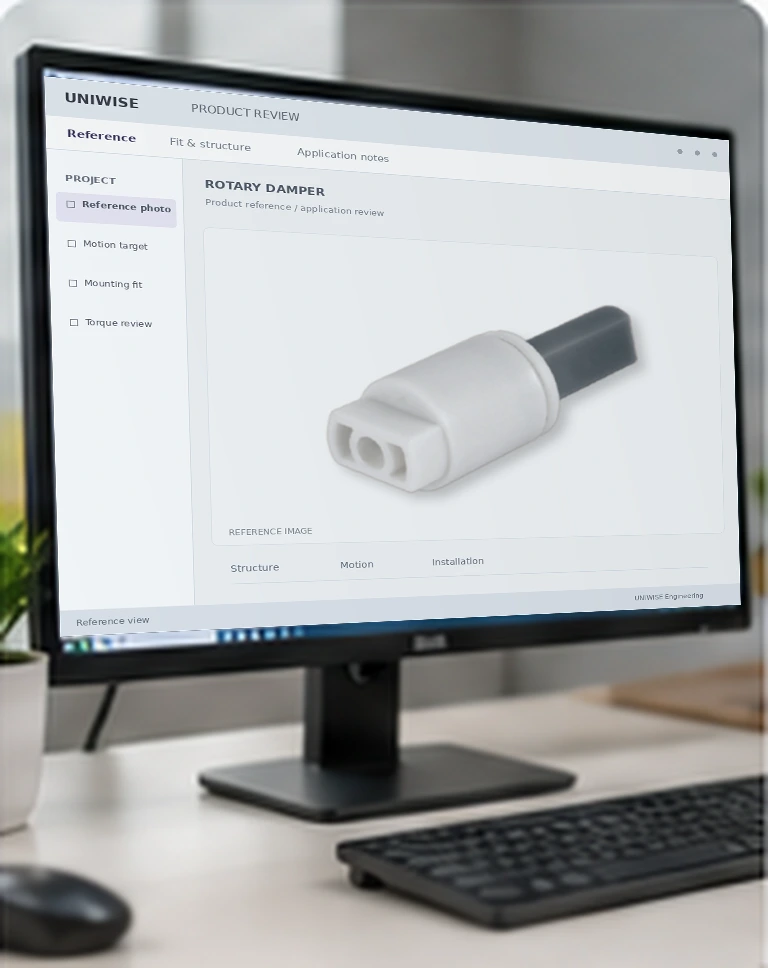
Compare torque, interfaces and suitable standard or custom options.

Review prototype and component details before sample evaluation.
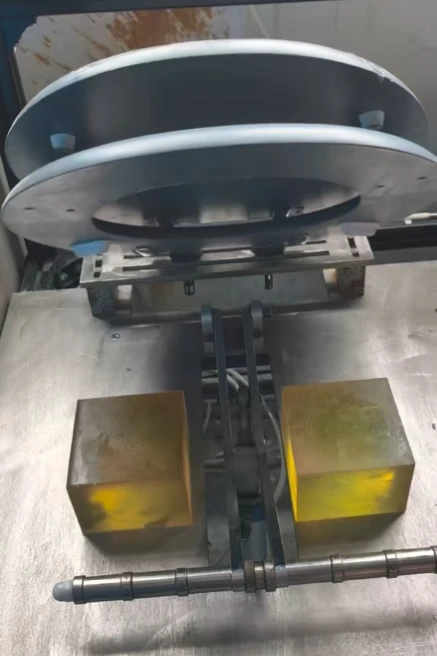
Check fit and movement in the real mechanism before approval.
Standard or custom
A new mould is not always the first step. We begin by reviewing existing parts, then discuss changes only where the application calls for them.
Check standard dimensions →Compare size, rotation direction, motion function and the published torque range.
Review special torque, shaft forms and mounting geometry. Final scope is agreed after technical review.
For projects beyond the standard range, discuss structure, prototype evaluation and tooling requirements.
Selection essentials
Changing the centre of gravity changes the load torque acting about the hinge. It does not automatically change a damper's rated torque.
The motion also depends on opening angle, temperature, speed, friction and any spring assistance. Dimensions alone do not confirm compatibility.
Request application matching →Moving-part weight, pivot-to-centre-of-gravity distance, installation dimensions, opening angle and target closing behaviour. Add a drawing or a short description of the mechanism.
For an initial estimate on a roughly uniform lid, 50% of its depth can be a starting assumption. Reinforcement, motors or uneven geometry can shift it; confirm the actual value before final selection.
Assess the lid and seat ring separately: their masses, centres of gravity and movement requirements can differ. Then review the complete hinge assembly.
No. Position-holding and slow-closing are different functions. Confirm the required movement and the model's intended function before comparing torque values.
Application support
Send the information you have. We will identify what needs to be confirmed.